Creative publications:
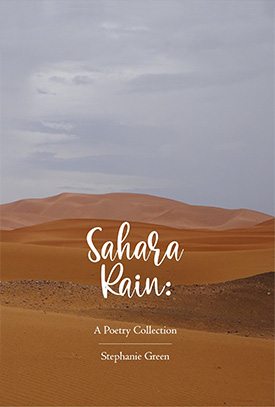
Sahara Rain
Liquid Amber Press, Sept 2026
These poems turn around spaces left behind – beaches slipping into seas, cities altered by war, the lacunae of memory. They dwell in the pause before reckoning,, in subtle movements of change. At once intimate and expansive, this collection asks what home means when the world itself is unsettled, and how we might listen again to the voices of earth, of lost loves and the quiet objects that share our endurance.
Jane Frank
Stephanie Green’s poems combine passionate concern with tender examination of the ‘erosions’ of environment, war and relationships. Landscape grounds these poems, from ‘the mineral taste’ of the Sahara, to Norway and Antarctica. Limpid imagery and unsettling questions create vulnerable poems, celebrating the ‘green flames of the living world.’ These poems will provoke you, move you and change you. Savour them.
Cathy Altmann
Purchase Sahara Rain
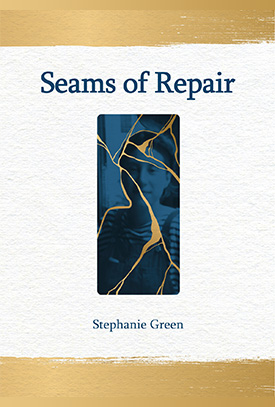
Seams of Repair
Calanthe Press, 2023
[I]t’s not too surprising that so much recent literature has been centered around themes of loss, grieving, and healing. Seams of Repair would seem to be part of this tendency, and its title (as well as its cover) points to the power of restoration, where the mending of breakage is reliant on the strength of its craft. It is a work which gently yet repeatedly reminds us that such artfulness is also re-pairing: a joining of two distinct entities, whether they be the parent with child, the lover with the absent partner, or even the author with the necessary reader….
[W]e are offered insights which can cause us to re-cognise what we have failed to notice and appreciate in our own lives, and maybe even where we might have been remiss in our love, and the expression of that love. At the same time, loss can also create a dearth of feeling – or alternatively, a feeling so large it can only be one thing: “You feel nothing now, except the touch of time.” – ‘First Night’. With aching frankness and humility, we are often shown the melancholy, frustration, and lucidity that occurs when the memory of a loved one insists on returning….
Yet the gravity of grief is lightened at times by a subtle, knowing levity in pieces such as ‘Romans’ (a homage to Anita Loos), ‘They Won’t be Quiet’ (in which ‘marvellous crones grin into mirrors of unmaking’), and ‘Oysters’, with its gentle mockery of male oral bluster and sexual inclinations….
For me, [the] understated cries are the dark yet luminous gold threads of kintsukuroi (referred to in the ‘Foreword’ and the opening poem) which bind the individual poems, as well as highlighting and strengthening the beauty of the whole work.
Matt Hetherington
Purchase Seams of Repair
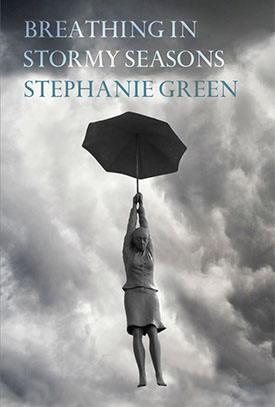
Breathing in Stormy Seasons
Recent Work Press, 2019
[Green’s] ‘moments of poetry’ are snapshots of existentialist joy and angst, alluding to a vast store of theoretical and practical goods.
[Her] usual strategy is to write a paragraph… which describe a moment of connection between the human and non-human world, often located in a place of scenic beauty; or to focus on a moment of intimacy between (usually) two personas (often) on a journey together, or located in their domestic routines. Her final sentence will then move from the concrete scene to the crystallization of a transcendent insight (often involving joy, sadness, loss, or wonder). Her prose displays a wonderful ear for conversational rhythms and alliterations, and she is deft in her use of imagism.
Phillip Hall
Purchase Breathing in Stormy Seasons
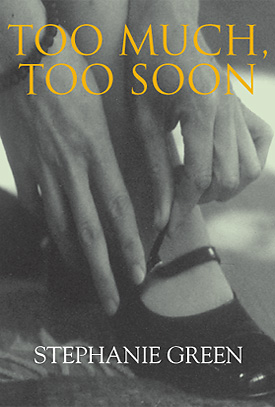
Too Much, Too Soon
Pandanus Press, 2006
You can never be ready enough for what life brings you. Too Much, Too Soon will lead you on journeys of desire, adventure and loss. In these stories, a girl learns about love through a recipe. A circus comes to an early twentieth-century farming community. A romance writer overcomes loneliness by seeking the advice of a fortune-teller. Recovering from shock, a man remembers the trauma of his wife’s suicide. At the end of a marriage, a young woman counts what she has lost.
From the rampant innocence of young girlhood to the poignancy of middle age, these stories of women and the men they know are fierce, funny, sharp, tender and occasionally tragic. A widely published writer of short fiction, poetry and criticism, Stephanie Green now offers her first collection. With this volume her distinctive voice can be clearly heard.
Pandanus Press
Academic book publications:
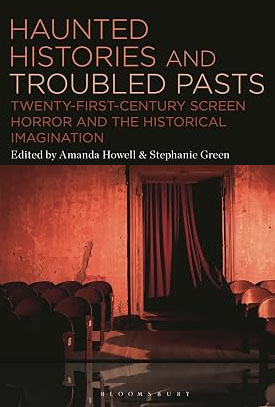
Haunted Histories and Troubled Pasts
With Amanda Howell (eds)
Bloomsbury, 2024
This timely collection considers the uneasy but productive relationship between genres of horror and history. The essays throughout consider multiple ways that horror may shape historical awareness and popular understanding of the past. Horror narratives are means for a society to engage with deep trauma, or to express ongoing pain and suffering as related to historical events. From zombies to witches, across TV and film and from the USA to Japan to Serbia, these thoughtful interventions allow us to understand the the multiple and complex ways that horror tropes create, challenge and interrogate historical narratives and authority.
Jerome de Groot, University of Manchester
While horror relies on fight or flight responses to actual and imagined threats, as Howell and Green remind us, This kind of viewing is less about being “in the moment” and more about being drawn and quartered by history. Each chapter reminds us how the genre, like nightmares, amplifies the atemporality of suffering. Where spun through the metaphor of Penny Dreadful’s monsters, the taking of an Aboriginal child’s wonder and magic, the sexual aberrations of the ostracized or homicidal inbred clans marked by deprivation, Haunted Histories and Troubled Pasts eloquently dissects the undead nature of collective trauma,
Terrie Waddell, La Trobe University
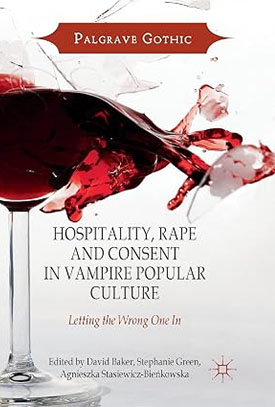
Hospitality, Rape and Consent in Vampire Popular Culture
With David Baker and Agnieszka Stasiewicz-Bienkowska (eds)
Palgrave MacMillan, 2017
The essays in this volume offer astute and complex readings of the vampire legend, offering new, original and creative interpretations. This is a stimulating and challenging collection that opens up new questions just when we thought that there was very little left that could be said about our troubled relationship with vampires and what might occur when we invite the wrong one in.
Barbara Anne Creed, University of Melbourne
This unique study explores the vampire as host and guest, captor and hostage, a prefect lover and a force of seductive predation. From Dracula to Carmilla, to True Blood and The Originals, the figure of the vampire embodies taboos and desires about hospitality, rape and consent. The first section welcomes the reader into ominous spaces of home, examining the vampire through concepts of hospitality and power, the metaphor of threshold, and the blurred boundaries between visitation, invasion and confinement. Section two reflects upon the development of vampire narratives and the monster as oppressed, alienated Other. Section three discusses cultural anxieties of youth, (im)maturity, childhood agency, abuse and the age of consent. And the final section addresses the vampire intimate partner, mapping boundaries between invitation, passion and coercion. This book will appeal to students and scholars of the Gothic looking for a new and insightful angle on a classic subject.
Palgrave MacMillan
The Public Lives of Charlotte and Marie Stopes
Pickering and Chatto, 2013
Charlotte Carmichael Stopes was the first woman in Scotland to gain a university qualification. She devoted her life to the study of Shakespeare and to the promotion of women in public life. Though Charlotte is largely forgotten, her daughter Marie is well known as a passionate advocate of sex education and women’s rights. In this study Green asserts that Marie’s success can only be understood in relation to the achievements of her mother. The careers of the two women are further used to argue that scholarly success in the late nineteenth and early twentieth century was only possible through sustained engagement with the (male) establishment.
Pickering and Chatto
Green performs a valuable service in resucing Charlotte Carmichael Stopes from the condescension of posterity, exploring her milieu of the late nineteenth-century women’s movement, and positioning her better-known daughter Marie more firmly as very much a second generation feminist. It provides illuminating insights into the shifts of focus between successive generations of feminism in the context of this specific mother-daughter relationship..
Lesley Hall, Wellcome Library